
Emergent Aquatic Plant Species
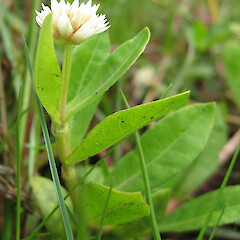
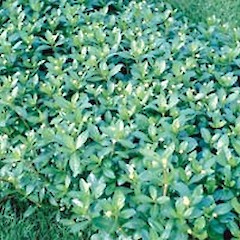
Alternanthera philoxeroides (Alligator Weed)
Family: Amaranthaceae
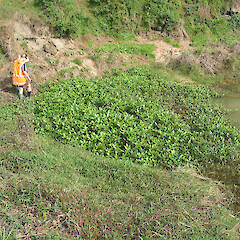
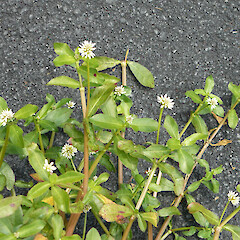
Alligator weed is a fast-growing, non-native perennial that spreads by sprawling across wet ground or shallow water margins. It can form thick mats up to 1 metre tall, posing significant challenges in wetlands, pasture, croplands, and drainage systems. The plant thrives in both freshwater and brackish conditions but typically does not root in water deeper than 2–3 metres. In shallow zones, it can float over deeper areas by anchoring at the edges.
Currently, this invasive species is well established in Northland and Auckland, with isolated populations in Waikato, Bay of Plenty, and Manawatū–Whanganui.

Myriophyllum aquaticum (Parrot’s Feather)
Family: Haloragaceae
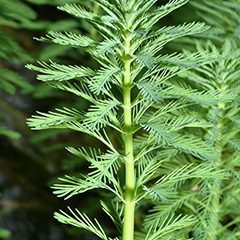
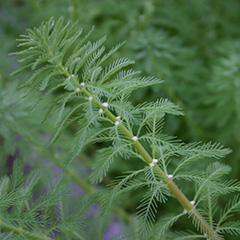
Parrot’s feather is a robust aquatic plant with rhizomatous stems and finely dissected leaves. It grows in both flowing and still water and can also spread along muddy banks and shallow wetlands. This species can form dense surface mats in water less than 2.5 metres deep, contributing to waterway blockages.
A close relative of native milfoils, parrot’s feather spreads rapidly through fragmentation and lateral stem growth. It is expanding throughout much of the North Island and has become established in parts of the northern South Island.

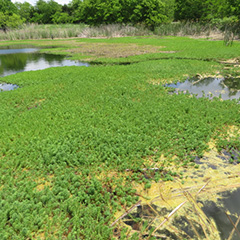
Ludwigia Species (Water Purslane & Primrose Willow)
Family: Onagraceae
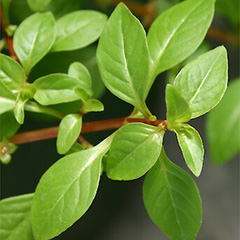
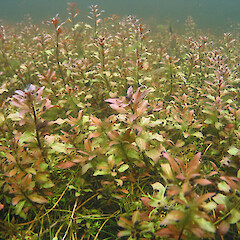
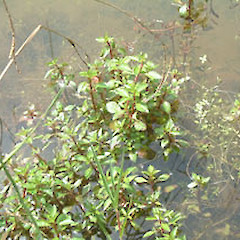
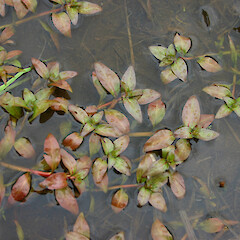
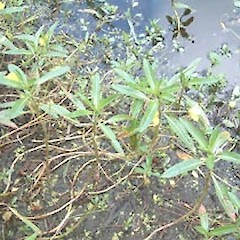
These two introduced Ludwigia species—Ludwigia palustris (water purslane) and Ludwigia peploides subsp. montevidensis (primrose willow)—are found along the margins of calm waterbodies such as lakes, ponds, and slow-flowing drains. Both species can extend across deeper water by forming floating mats.
- L. palustris has reddish, opposite leaves up to 3 cm long and winged petioles. It produces small, petal-less flowers in the leaf axils.
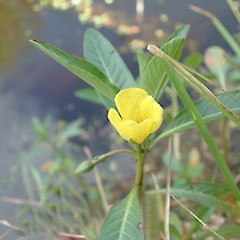
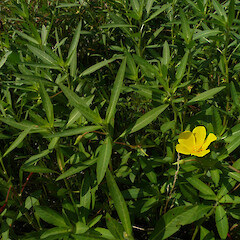
- L. peploides features alternate, glossy green leaves up to 6 cm long, with distinctive green stipules at the base. It is known for its bright yellow summer flowers up to 2 cm wide.
Both species propagate via rooting stems and are well adapted to shallow, protected wetland habitats.


Family: Poaceae
Glyceria maxima (Reed Sweet Grass)
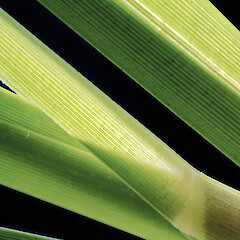
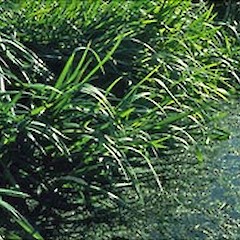
Reed sweet grass is a robust grass species introduced from Europe. It has stout, upright stems and spreads rapidly by creeping rhizomes. It forms dense clumps along the edges of lakes, rivers, and drainage channels. Its sheaths are often closed—unusual among grasses—and it produces compact, branched panicles with numerous spikelets.
Common in the Waikato and Hauraki Plains, and some parts of Otago, Glyceria can obstruct water flow and is occasionally linked to cyanide poisoning in livestock, despite being palatable.
Zizania latifolia (Manchurian Wild Rice)
Family: Poaceae
Native to Asia, Manchurian wild rice is a coarse, tall-growing perennial (2–5 m) with a vigorous rhizome network. It typically establishes on river berms but can invade swamps and pastures. The plant tolerates both freshwater and brackish conditions.
Although it rarely flowers or sets seed in New Zealand, its spread is facilitated by rhizome growth and waterborne fragments. It was introduced via ship ballast in the early 1900s and now occurs from Northland to Auckland and along the Wairoa River.



Persicaria decipiens (Swamp Willow Weed)
Family: Polygonaceae
Swamp willow weed is a native annual herb that grows upright to 0.5–1 metre tall. It prefers fertile wet margins of streams, swamps, and floodplains, especially in the North Island.
The plant has reddish stems and long, narrow, lance-shaped leaves with sheathing stipules. The leaf surface may be blotched or reddish. Slender pink flower spikes droop near their tips, and the dark brown lens-shaped seeds are an important food source for waterfowl, which help spread them.

For further information on these plants species see:
B.T. Coffey and J.S. Clayton. (1988). New Zealand Waterplants: A guide to plants found in New Zealand. Ruakura Agriculture Centre, Hamilton.
Free-Floating Aquatic Weed Species
Azolla filiculoides
Family: Azollaceae
Azolla filiculoides is a small, free-floating aquatic fern commonly found on nutrient-rich still waters such as ponds, lakes, and drains. It often forms a striking red carpet-like cover, particularly under full sunlight. The plant is typically 1–2.5 cm long and has a compact, ovate shape. Its tiny, overlapping leaves grow alternately along branching stems, often concealing the horizontal structure beneath. Roots are thin, unbranched, and can reach up to 5 cm in length. Azolla reproduces through both vegetative growth and spore production.
This native species is widespread across New Zealand but can be mistaken for Azolla pinnata, an introduced species found mainly in the upper North Island. A. pinnata can be identified by its more open branching habit and its feather-like roots that split into numerous fine hairs.
Lemna minor (Duckweed)
Family: Lemnaceae
Commonly known as duckweed, Lemna minor is a tiny, free-floating plant frequently seen covering sheltered, nutrient-rich water surfaces. It is native to New Zealand and occurs widely throughout the country.
If you’re struggling with duckweed, ProcellaCOR is highly effective as a duckweed killer for ponds, delivering fast action with minimal impact on fish and wildlife.
Each plant consists of 2 to 4 small leaf-like structures (3–4 mm long), each with a single root capped by a prominent root tip. This root structure helps distinguish it from species like Spirodela punctata and other introduced duckweeds, which usually have multiple roots per leaflet.
Eichhornia crassipes (Water Hyacinth)
Family: Pontederiaceae
Water hyacinth is a robust, free-floating perennial known for forming thick mats that choke lakes, ponds, and waterways. It has smooth, glossy green leaves with bulbous, spongy stalks that help with buoyancy. Thick, horizontal stolons extend outward from a central upright stem. The plant produces eye-catching bluish-purple flowers about 6 cm across, clustered on an upright spike.
Once introduced to New Zealand as a decorative pond plant, water hyacinth has been largely eradicated from natural areas. It is now classified as an illegal species, though occasionally still found in private water gardens.
Salvinia molesta (Salvinia)
Family: Salviniaceae
Salvinia is a floating fern that changes appearance as it matures. Young plants feature small (1.5 cm), light green leaves spaced along a stem, lying flat on the water surface. As they mature, the leaves become crowded and brownish, folding upward to form dense mats. Plants can grow up to 30 cm in length. Each node bears a whorl of three leaves—two float on the surface while the third dangles beneath and mimics a root. The top leaf surfaces are water-repellent and covered with characteristic white hairs.
Salvinia thrives in warm, protected waters and struggles in frost-prone environments. It grows best in temperatures above 20°C and is found in areas north of Waikato. Although a major pest in tropical regions due to its rapid growth, salvinia is a restricted species in New Zealand, occasionally found in private ponds.
For further information on these plants species see:
B.T. Coffey and J.S. Clayton. (1988). New Zealand Waterplants: A guide to plants found in New Zealand. Ruakura Agriculture Centre, Hamilton.
Submerged Aquatic Weed Species
Tall-Growing Species
Ceratophyllum demersum (Hornwort)
Family: Ceratophyllaceae
Hornwort is an introduced perennial plant that grows fully submerged in water. While its lower stems are often anchored in sandy or silty sediments, it does not produce true roots and is easily dislodged. When this happens, its buoyant stems can float freely. Hornwort often forms dense underwater canopies up to 5–6 m high, commonly dominating habitats as a single-species community.
The plant spreads through stem fragments, as its brittle stems readily break apart. Although it produces flowers, there is no evidence that seeds form in New Zealand. Hornwort is found from Northland to Wairarapa and is still expanding its range, particularly abundant in the Waikato River system and Rotorua lakes.
Myriophyllum propinquum & Myriophyllum triphyllum (Milfoils)
Family: Haloragaceae
These native submerged macrophytes are widespread across New Zealand, occurring in both still and flowing waters. They can grow up to 3 m tall in water as deep as 3.5 m. Both species tolerate temporary drying and, in such conditions, M. propinquum can form a low-growing herb up to 10 cm tall.
From November to March, both species are easily identified by their distinctive reddish flower spikes that emerge above the water. M. propinquum typically has separate male and female flowers on the same plant, while M. triphyllum usually bears hermaphrodite flowers. These species reproduce both from seed and vegetatively via rhizomes and stem fragments.
Hydrilla verticillata (Hydrilla)
Family: Hydrocharitaceae
Hydrilla is an invasive, much-branched perennial that forms thick, single-species stands reaching the water’s surface from depths of up to 6.5 m. It spreads quickly using stolons, rhizomes, and stem fragments. The plant also produces underground tubers and axillary buds (turions), but because only male plants are present in New Zealand, seeds are not formed.
In New Zealand, Hydrilla is restricted to a few lakes in Hawke’s Bay, including Lakes Tūtira, Waikapiro, Opouahi, and Elands Lake.
Egeria densa (Egeria)
Family: Hydrocharitaceae
Egeria is a rooted, perennial aquatic plant that thrives in slow-moving, nutrient-rich waters. It typically forms dense monocultures up to 5 m tall, with stems reaching the surface. Like Hydrilla, only male plants are present in New Zealand, so it does not reproduce by seed here.
Propagation occurs through stem fragments, and its small white flowers can be seen floating at the surface during summer. Egeria is common in the Waikato region, is scattered across the North Island, and is increasingly recorded in Marlborough and Canterbury. It has also recently been found in Christchurch’s Avon River.
Lagarosiphon major (Lagarosiphon)
Family: Hydrocharitaceae
Lagarosiphon is an invasive submerged plant capable of growing from shallow margins down to 6.5 m. It forms thick single-species stands and can quickly outcompete native plants in clear waters.
This species spreads rapidly via stem fragments, often transported between waterbodies by boats and trailers. Only female plants are present in New Zealand, so reproduction is entirely vegetative. Lagarosiphon is found throughout much of the country, with its range continuing to expand.
Elodea canadensis (Elodea)
Family: Hydrocharitaceae
Elodea is a submerged perennial plant that forms less dense canopies compared to the other Hydrocharitaceae species. It can grow up to 5 m tall and, in very clear water, may be found at depths of up to 10 m.
Elodea spreads entirely by stem fragments. It is the most widespread of the introduced tall-growing submerged species in New Zealand and occurs throughout both islands.
Vallisneria gigantea (Eelgrass)
Family: Hydrocharitaceae
Vallisneria, or eelgrass, is a tall, rooted perennial with strap-like leaves that can reach 5 m in length. It forms dense colonies on lake beds, growing at depths of up to 9 m.
The species reproduces vegetatively through stolons, as no viable seed has been observed in New Zealand populations. Its current distribution is limited to a few North Island lakes, most notably Lake Pupuke.
Potamogeton Species (Pondweeds)
Family: Potamogetonaceae
Potamogeton crispus (Curly-Leaved Pondweed)
This adventive species can be problematic in flowing water and tolerates slightly brackish conditions. It grows up to 4 m tall, and in shallow water may behave like an annual. It spreads by seed, stem fragments, and vegetative buds (turions).
P.crispus is widespread in the North Island and is also found in Marlborough and Canterbury, with its range still expanding.
Potamogeton ochreatus
This native pondweed grows in silty or stony substrates and can be found at depths of up to 10 m in clear lakes, though it is more common in shallower or turbid waters. It reproduces both by seed and vegetatively and is widely distributed across New Zealand.
Ranunculus trichophyllus (Water Buttercup)
Family: Ranunculaceae
This introduced perennial has finely divided leaves and stems up to 3 m long. It may grow upright in still waters or trail extensively in rivers and streams. Its small white flowers, typically less than 15 mm across, rise above the water surface in spring and summer.
Water buttercup spreads by seed and stem fragments and is found widely across New Zealand, except in the Northland lakes.
Ruppia Species (Horses’ Mane Weed)
Family: Ruppiaceae
The native species Ruppia megacarpa and Ruppia polycarpa typically inhabit shallow waters up to 2 m deep. R. megacarpa is usually found in coastal saline or brackish waters, while R. polycarpa occupies a wider range of habitats, including estuaries and freshwater lakes.
Both species are identifiable by their thread-like leaves and small terminal flowers. After pollination, the flower stalk retracts, pulling the developing seeds underwater. The fruit of R. megacarpa are larger and fewer per flower compared to R. polycarpa.
Low-Growing Species
Chara Species
Family: Characeae
The native charophytes Chara corallina and Chara globularis form underwater meadows that may reach 2 m tall in deep lakes or remain as short tufts in shallow waters. These species reproduce via vegetative fragments and oospores, which can be dispersed by birds. Charophytes are often the first plants to colonise new waterbodies and are found throughout New Zealand.
Nitella Species
Similar in appearance to Chara, Nitella species create dense underwater meadows, particularly in clear deep lakes where they can grow at depths of up to 40 m. They propagate through fragments and spores and are widespread across New Zealand.
Elatine gratioloides
Family: Elatinaceae
This small, mat-forming herb grows along the margins of lakes and rivers, often in shallow water. It produces small paired leaves and inconspicuous flowers in the leaf axils. Elatine spreads by both seed and vegetative growth and is found nationwide.
Myriophyllum pedunculatum
Family: Haloragaceae
This native species forms turf-like mats in shallow water or damp ground. It grows less than 10 cm tall and has tiny leaves and pinkish flowers in the upper leaf axils. It reproduces by seed and vegetatively and occurs throughout New Zealand.
Isoetes kirkii
Family: Isoetaceae
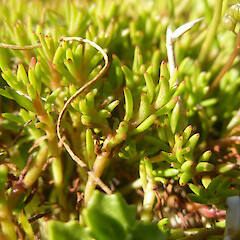
Isoetes is a native perennial forming dense tufts of stiff, cylindrical leaves up to 30 cm long. It prefers clear, low-nutrient waters and is common in lakes and streams across the country.
Ranunculus limosella
Family: Ranunculaceae
This slender creeping species grows in shallow lakes and waterways from coastal areas to inland sites. It produces small entire leaves and delicate pinkish flowers on short stalks. It is vulnerable to habitat modification and eutrophication.
Glossostigma Species
Family: Scrophulariaceae
The native species Glossostigma diandrum and Glossostigma elatinoides grow as low mats in shallow waters or on damp margins. They spread by seed and creeping stems. The species are distinguished by their leaf shapes and flower structures.
Lilaeopsis ruthiana
Family: Apiaceae
This turf-forming plant resembles a fine grassy sward, with thread-like leaves and creeping rhizomes. It grows in shallow lakes, swamps, and streams and spreads by seed and rhizome fragments.
Floating-Leaved Species
Callitriche stagnalis (Starwort)
Family: Callitrichaceae
Starwort is a bright green plant that forms patches of floating vegetation, often obstructing water flow in drains. It can grow up to 1 m tall when submerged or spread as a prostrate mat on damp ground.
This adventive species reproduces through creeping stems, seeds, and small solitary flowers. It is widely distributed in New Zealand.
Ottelia ovalifolia (Swamp Lily)
Family: Hydrocharitaceae
Swamp lily is a heterophyllous species with submerged ribbon-like leaves when young and broad floating leaves as it matures. Its white, orange-centred flowers are held above the water surface.
This adventive species is most common in Northland and grows in farm dams and lakes up to 3 m deep.
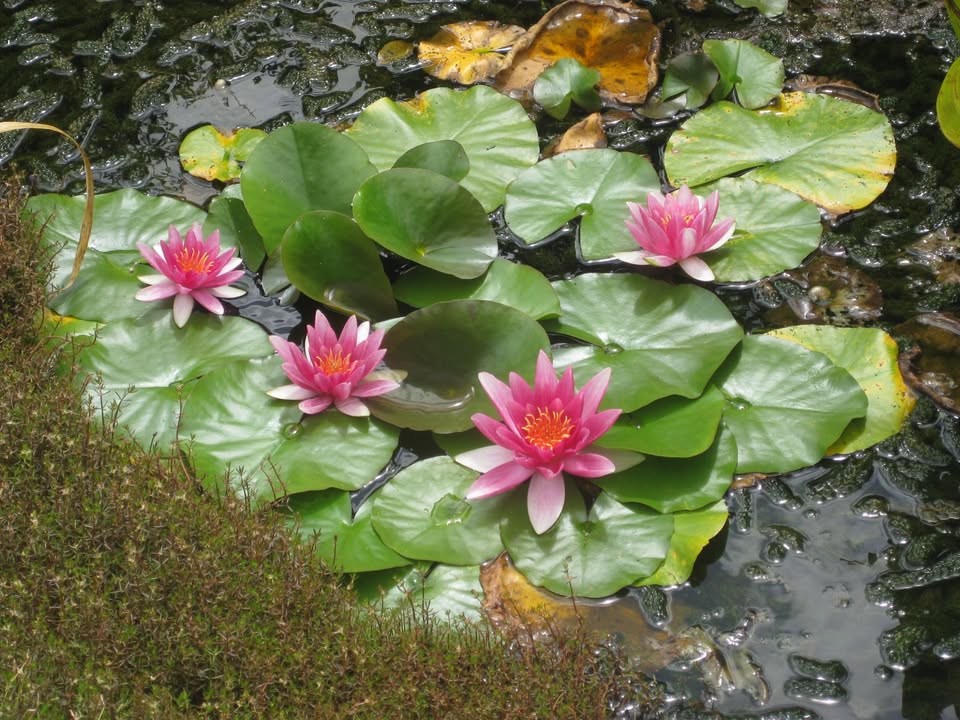
Nymphaea Species (Water Lilies)
Family: Nymphaeaceae
These iconic plants are widely grown in ornamental ponds for their colourful summer flowers. Water lilies have large rounded leaves that float on the surface and creeping rhizomes buried in sediment.
Most species present in New Zealand are introduced and many are sterile hybrids that do not produce viable seeds.
Potamogeton cheesemanii (Pondweed)
Family: Potamogetonaceae
This native species occurs in both rivers and lakes and can grow to depths of 8 m. It produces both submerged and floating leaves and spreads primarily by seed. Pondweed is common and widespread throughout the country.
For further information on these plants species see
B.T. Coffey and J.S. Clayton. (1988). New Zealand Waterplants: A guide to plants found in New Zealand. Ruakura Agriculture Centre, Hamilton.
Family: Amaranthaceae
Description & Traits:
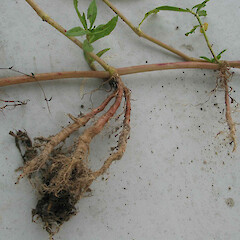
- Alligator weed is a fast-growing, non-native perennial that spreads via creeping stems (stolons) and root fragments.
- It forms thick mats, grows up to around 1 metre tall in shallow margins, often floating mats over deeper water anchored at edges.
- Leaves are opposite, waxy, generally dark green, with hollow stems; flowers are small and white.
Habitat & Tolerance:
- Grows in freshwater and brackish margins; can tolerate wet soil and shallow water, but usually does not root in water deeper than 2-3 metres.
- Thrives in sunny spots but can tolerate some shading; very hardy in disturbed sites, drainage channels, wetlands, pond edges, and pasture margins.
Distribution in NZ:
- Well established in Northland and Auckland; also found in Waikato, Bay of Plenty, and Manawatū-Whanganui in patches.
Why It’s a Problem:
- Blocks waterways, disrupts drainage, increases flood risk.
- Outcompetes native plants, reduces habitat for aquatic wildlife.
- Spread is mainly via stem fragments transported by water, machinery, boats, soil etc.
Sources:
NIWA “Emergent aquatic plants” species-guide; Waikato Regional Council info; Bay of Plenty Regional Council fact sheets.
Earth Sciences New Zealand | NIWA+2Waikato Regional Council+2
Myriophyllum aquaticum (Parrot’s Feather)
Family: Haloragaceae
Description & Traits:
- Parrot’s feather has finely divided, feather-like leaves arranged in whorls (often 4-6) around stems.
- The plant can have both submerged and emergent stems; emergent portions (above water) are stiff and leafy, often rising ~10-30 cm above the surface.
- Only female plants are found in NZ; reproduction is via fragmentation and lateral stem growth.
Habitat & Tolerance:
- Grows in still or slow-moving freshwater bodies, margins, wetlands; also found in disturbed or polluted waters.
- Needs light and nutrients; thrives in high nutrient, well-lit conditions.
Distribution in NZ:
- Widely naturalised in the North Island, including Auckland, Waikato, Wairarapa, Manawatū; scattered in parts of the South Island.
Why It’s a Problem:
- Forms dense mats on water surfaces, blocks sunlight, reduces oxygen in water, impacts native species.
- Impedes waterways, recreation, and sometimes infrastructure (e.g. irrigation).